

Introduction
Remote patient monitoring used to mean a nurse calling to check in once a week. Today, it means a wearable device quietly tracking a patient's heart rate, oxygen levels, and glucose in real time — and an AI system flagging a problem hours before it becomes an emergency room visit.
For U.S. healthcare providers, AI-powered remote patient monitoring (RPM) software isn't just a convenience anymore. It's becoming one of the most practical ways to manage chronic conditions, reduce hospital readmissions, and extend quality care to patients who live far from a clinic. If you're a hospital system, a telehealth company, or a health-tech founder in the USA exploring RPM software, this guide walks you through exactly what to build, why it matters, and what to watch out for.
What Is AI-Powered Remote Patient Monitoring?
AI-powered remote patient monitoring is a system that collects health data from patients outside a traditional clinical setting — usually through wearables, connected medical devices, or mobile apps — and uses artificial intelligence to analyze that data in real time.
Instead of a doctor manually reviewing charts, the AI does the heavy lifting: spotting unusual patterns, predicting potential complications, and alerting care teams only when something actually needs attention. This means patients with chronic conditions like diabetes, hypertension, or heart disease can be monitored continuously, without needing to sit in a waiting room every few weeks.
Why Remote Patient Monitoring Matters for U.S. Healthcare Right Now
The American healthcare system is under real pressure. Chronic disease management alone accounts for a huge share of national healthcare spending, and hospitals are penalized under CMS guidelines for high readmission rates. At the same time, there's a growing shortage of primary care physicians, especially in rural parts of the country.
AI-powered RPM software directly addresses all three problems:
- It keeps chronic disease patients stable at home, reducing the need for costly hospital visits
- It helps hospitals avoid CMS readmission penalties by catching complications early
- It extends access to patients in rural or underserved U.S. regions who can't easily reach a specialist
This is exactly why RPM has become one of the fastest-growing categories inside the broader move toward AI healthcare software development in the U.S. digital health market.
It's also worth noting that patient expectations have shifted. People managing a chronic condition don't want to take a half-day off work for a routine check-in when a connected device could send the same information automatically. For U.S. providers, offering AI-powered RPM isn't just about efficiency anymore — it's quickly becoming a baseline expectation for modern, patient-centered care.
How AI-Powered RPM Fits Into the Bigger Care Model
Remote patient monitoring works best when it's not treated as a standalone gadget, but as one connected piece of a patient's overall care journey. A well-built RPM platform feeds data into the same system a physician already uses for appointments, prescriptions, and lab results, so nothing falls through the cracks between visits.
This is particularly important for value-based care models, where U.S. providers are increasingly paid based on patient outcomes rather than the number of visits or procedures performed. AI-powered RPM gives providers continuous visibility into how a patient is actually doing between appointments — data that used to be a complete blind spot in traditional care delivery.
Key Features of AI-Powered Remote Patient Monitoring Software
1. Real-Time Vitals Tracking and Wearable Integration
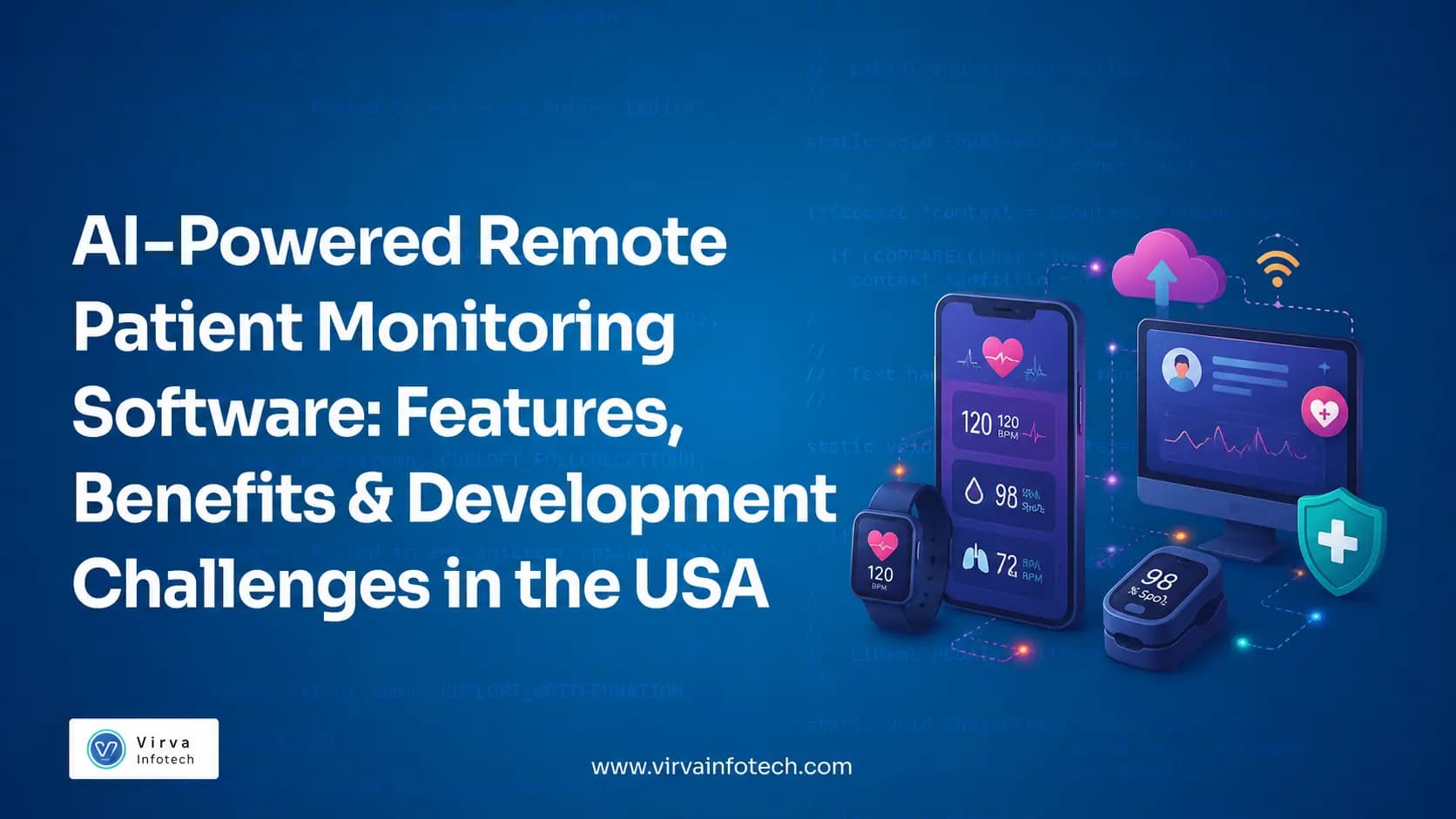
The foundation of any RPM platform is its ability to pull data from wearables and connected devices — blood pressure cuffs, glucose monitors, pulse oximeters, and smartwatches — and display it in a clean, real-time dashboard for both patients and providers.
2. AI-Based Anomaly Detection and Smart Alerts
Rather than flooding care teams with every data point, AI models learn what "normal" looks like for each patient and only send alerts when something genuinely deviates from that baseline. This cuts down on alert fatigue, a common complaint among U.S. clinicians using older monitoring tools.
3. Predictive Analytics for Early Intervention
Good RPM software doesn't just react — it predicts. By analyzing trends over days or weeks, AI can flag a patient who's likely heading toward a health crisis, giving care teams time to intervene before an ER visit is even necessary.
4. EHR and EMR Integration
For RPM software to be genuinely useful in a U.S. clinical setting, it needs to plug directly into existing Electronic Health Record systems. This ensures physicians see monitoring data alongside the rest of a patient's medical history, not in a separate, disconnected app.
5. Patient Engagement Dashboard and Mobile App
Patients need a simple way to see their own data, get reminders, and communicate with their care team. A well-designed patient app significantly improves adherence, especially among older patients managing multiple chronic conditions.
6. HIPAA-Compliant Secure Data Transfer
Because RPM software handles continuous streams of sensitive health data, encryption, secure cloud storage, and strict access controls aren't optional. Every layer of the platform needs to be built around HIPAA compliance from day one.
7. Telehealth and Video Consultation Integration
Many RPM platforms now include built-in telehealth features, allowing a provider to jump straight from a monitoring alert into a video consultation, without asking the patient to switch apps or reschedule.
Benefits of AI-Powered RPM Software
- For Patients: Fewer hospital visits, more independence, and the peace of mind that comes from knowing their care team is watching their vitals even when they're not in a clinic.
- For Healthcare Providers: Lower readmission rates, better chronic disease outcomes, and the ability to manage more patients without proportionally increasing staff.
- For Payers and Health Systems: Reduced overall cost of care, fewer emergency interventions, and stronger performance under value-based care and CMS quality metrics.
- For the Broader U.S. Healthcare System: Better access to care in rural and underserved areas, where in-person specialist visits are often limited or hours away.
AI-Powered RPM Development Challenges (And How to Solve Them)
Building RPM software sounds straightforward on paper, but U.S. healthcare providers and health-tech founders run into real challenges during development.
Device and Data Integration Complexity
There are dozens of wearable and medical device manufacturers, each with different data formats and APIs. A strong RPM platform needs flexible integration architecture that can handle multiple device types without constant custom rebuilding.
Solution: Build around standardized health data protocols like FHIR and HL7 from the start, rather than hardcoding integrations device by device.
HIPAA and FDA Compliance
Any software handling continuous patient vitals falls under strict HIPAA privacy rules, and depending on its function, may also require FDA clearance as a medical device or clinical decision-support tool.
Solution: Compliance can't be an afterthought. It needs to shape the architecture, data flow, and even the UI decisions from the earliest design stage.
Interoperability with Existing Hospital Systems
Many U.S. hospitals run on legacy EHR systems that weren't designed with modern AI tools in mind, making integration slower and more expensive than expected.
Solution: Prioritize interoperability testing early in development instead of treating it as a final-stage integration task.
Patient Adoption and Usability
Even the most advanced AI monitoring system fails if patients — especially older adults — find it confusing or intrusive.
Solution: Design for simplicity first. Fewer steps, clear alerts, and minimal manual data entry lead to significantly higher long-term adoption.
AI Model Accuracy Across Diverse Patient Populations
AI models trained on limited or non-diverse datasets can produce inaccurate alerts for certain patient groups, which is a serious clinical risk.
Solution: Train and continuously validate AI models against diverse, representative patient data, with ongoing monitoring after deployment, not just at launch.
How to Approach RPM Software Development the Right Way
For U.S. healthcare organizations building or investing in RPM software for the first time, it helps to avoid trying to launch a fully loaded platform on day one. A more realistic approach looks like this:
- Start with one chronic condition — diabetes or hypertension monitoring, for example — rather than trying to cover every condition at once
- Choose a small set of reliable, well-supported devices instead of attempting to integrate every wearable on the market
- Run a pilot with a defined patient group and track real outcomes, not just usage numbers
- Bring compliance and clinical teams in early, not after the platform is already built
- Expand gradually into additional conditions, devices, and patient populations once the core system is proven
This phased approach keeps development costs manageable and gives providers real evidence of impact before scaling RPM across an entire health system.
The Business Opportunity in the USA
Remote patient monitoring sits right at the intersection of what U.S. healthcare providers need and what patients are actively asking for: convenient, continuous, and personalized care. Hospitals looking to reduce readmission penalties, telehealth companies expanding their service lines, and health-tech startups building chronic care platforms all have a real opening here.
This is one of the clearest examples of AI moving from a "nice to have" feature into a core part of American healthcare delivery — and it's a theme we cover in more depth in our pillar guide, AI Healthcare Software Development: Use Cases, Trends & Business Opportunities in the USA, which looks at the wider landscape of AI adoption across U.S. healthcare.
Why Build Your RPM Software with Virva Infotech
At Virva Infotech, we design and develop AI-powered remote patient monitoring software for U.S. healthcare providers, telehealth companies, and health-tech startups who need something that actually works in real clinical settings — not just in a demo. From wearable integration and predictive AI models to HIPAA-compliant architecture and EHR connectivity, our team builds RPM platforms around real patient outcomes and real compliance requirements.
To see how this fits into our broader healthcare development work, visit our Healthcare Industry Solutions page.
Final Thoughts
AI-powered remote patient monitoring is no longer an experimental add-on for U.S. healthcare providers — it's becoming a core part of how chronic disease is managed and how care reaches patients outside hospital walls. The providers and startups that get the development right, with strong compliance, real interoperability, and genuinely accurate AI, will be the ones leading this shift over the next few years.
If you're ready to build AI-powered remote patient monitoring software for your organization, Virva Infotech's healthcare development team can help you design it around real outcomes, not just features.