


Introduction
If you've ever sat in a meeting where someone mentioned "PyTorch," "MLOps," and "vector databases" in the same sentence, you know how quickly AI conversations can turn into alphabet soup. As a business owner, you don't need to become a machine learning engineer. But understanding the basic building blocks of an AI tech stack helps you ask better questions, evaluate proposals with confidence, and avoid overpaying for the wrong tools.
This guide breaks down the AI tech stack in plain English — what it is, what each piece actually does, and how it all comes together to build the kind of AI solutions we talked about in our complete guide to AI development services.
Here's why this matters even if you'll never write a line of code yourself: the tech stack a development team chooses directly shapes your timeline, your budget, and how reliable your AI solution is once it's live. Two teams can quote you similar prices for what sounds like the same project, but if one is building on outdated tools with no monitoring in place, you're likely to end up with a system that breaks down within a year. Understanding the stack, even at a high level, helps you tell the difference between a team that's set up for long-term success and one that's cutting corners.
What Is an AI Tech Stack?
An AI tech stack is the full collection of tools, frameworks, platforms, and infrastructure used to build, train, deploy, and maintain an AI system. Think of it like the ingredients and equipment behind a restaurant kitchen. The customer just sees a great meal, but behind the scenes there's a specific stove, specific ingredients, a prep process, and a system for keeping everything running smoothly night after night.
In AI development, that "kitchen" includes your data infrastructure, the frameworks used to build models, the tools used to manage and monitor those models, and the development environments engineers use to write and test code. Every layer matters, and skipping or underinvesting in any one of them tends to show up later as slow performance, unreliable results, or a system that's expensive to maintain.
The Core Layers of an AI Tech Stack
Let's break the stack down into its main components, from the ground up.
1. Data Layer
Every AI system starts with data. This layer includes where your data lives (databases, data warehouses, cloud storage), how it's collected, and how it's cleaned and organized before it's ever used to train a model. This is genuinely the most important layer of the entire stack. A brilliant model built on messy, incomplete, or poorly labelled data will still produce unreliable results.
2. Infrastructure and Compute
AI models, especially deep learning models, require significant computing power to train. This layer includes the servers, GPUs, and cloud resources (like AWS, Google Cloud, or Microsoft Azure) that power the actual training and running of AI models. Most U.S. businesses today rely on cloud infrastructure rather than owning physical hardware, since it scales up and down based on need without a massive upfront investment.
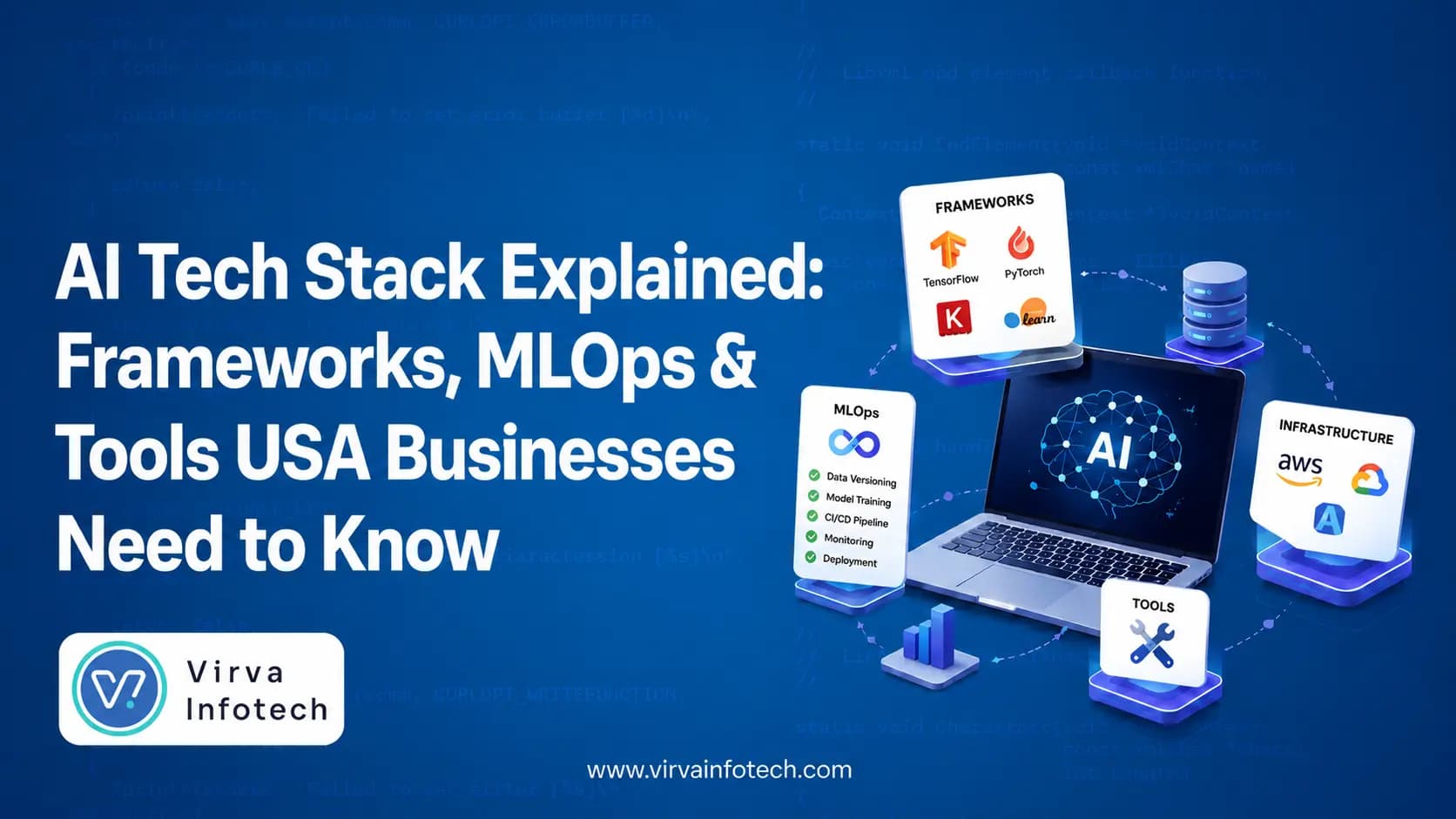
3. AI Frameworks and Libraries
Frameworks are the toolkits developers use to actually build AI models, instead of writing every mathematical function from scratch. The right framework depends on the type of project, the team's expertise, and how the model needs to perform once it's live.
4. MLOps (Machine Learning Operations)
MLOps is the set of practices and tools used to deploy, monitor, and maintain AI models after they're built. This is often the most overlooked layer, and it's one of the biggest reasons AI projects fail after launch. A model that worked perfectly in testing can quietly become less accurate over time as real-world data shifts. MLOps tools track that performance and flag when a model needs retraining.
5. Development Environments (IDEs)
These are the tools engineers use to actually write, test, and debug the code behind an AI system. While this layer is mostly invisible to business owners, the right development environment directly affects how quickly and reliably a development team can build and improve your AI solution.
6. Deployment and Integration Tools
Once a model is built and tested, it needs to be connected to the systems your business actually uses — your website, CRM, mobile app, or internal dashboards. This layer covers the APIs and integration tools that make an AI model usable in the real world, rather than just a working prototype sitting on a developer's laptop.
Popular AI Frameworks, Explained Simply
You don't need to memorize these, but recognizing the names helps when you're reviewing a proposal from a development team.
TensorFlow — Developed by Google, this is one of the most widely used frameworks for building deep learning models. It's known for being production-ready and well-suited for large-scale enterprise applications.
PyTorch — Backed by Meta, PyTorch has become a favourite among researchers and developers for its flexibility and easier learning curve. It's commonly used for building custom, cutting-edge AI models.
Scikit-learn — A simpler, lighter framework best suited for traditional machine learning tasks like classification, prediction, and pattern recognition. It's a great fit for businesses that need practical, straightforward predictive models rather than complex deep learning systems.
Hugging Face Transformers — This has become the go-to toolkit for working with large language models and natural language processing tasks, including many of the chatbot and conversational AI systems businesses use today. If you're exploring conversational AI for your business, our guide on AI chatbots for business shows how these frameworks translate into real customer-facing tools.
Open-source model families — Beyond frameworks, businesses are also increasingly evaluating open-source AI models themselves as an alternative to proprietary systems. Our breakdown of DeepSeek AI covers one of the more talked-about open-source models and what U.S. businesses should know before adopting it, particularly around data handling and security.
MLOps Tools That Keep AI Systems Running Smoothly
A model isn't "done" once it launches. It needs ongoing attention, and MLOps tools are what make that manageable at scale. Common categories include:
- Model monitoring tools that track accuracy and flag performance drops in real time
- Version control systems built specifically for machine learning, so teams can track changes to models and data over time
- Automated retraining pipelines that update models as new data becomes available
- Experiment tracking tools that help data science teams compare different versions of a model to find the best-performing one
For businesses running enterprise-scale AI systems, strong MLOps practices aren't optional; they're what separates a reliable AI investment from one that quietly degrades and stops delivering value. Our guide on AI enterprise software goes deeper into how larger organizations manage AI at scale, including the operational side that MLOps supports.
IDEs and Developer Tools Behind the Scenes
While these tools won't mean much to a non-technical business owner day-to-day, they're worth understanding at a high level because they affect development speed and quality.
Jupyter Notebooks — A widely used environment for testing and visualizing AI models step by step, especially popular in the early experimentation phase of a project.
Visual Studio Code — A flexible, widely adopted code editor used across nearly every type of software development, including AI, thanks to its extensions built specifically for machine learning workflows.
Google Colab — A cloud-based notebook environment that lets developers run AI experiments without needing powerful local hardware, useful for testing ideas quickly before committing to full development.
PyCharm — A more full-featured development environment popular for larger, more complex AI projects that require robust debugging and project management tools.
The specific IDE a development team uses matters less than how consistently and efficiently they use it. What you should really be evaluating is whether your development partner has a clear, organized process — not which specific tools appear on their resume.
How to Choose the Right AI Tech Stack for Your Business
You don't need to make these decisions yourself, but understanding the logic helps you have a more informed conversation with your development partner.
Start with the problem, not the tools. The right stack depends entirely on what you're building. A customer service chatbot needs a very different stack than a fraud detection system or a demand forecasting tool.
Think about scale from day one, even if you start small. A stack that works for a proof-of-concept but can't scale will need to be rebuilt later, costing more time and money. A good development partner designs with future growth in mind, even for an initial small-scale launch.
Factor in maintenance, not just development. As covered in our guide on AI development costs in the USA, the tools and infrastructure you choose directly affect ongoing costs, not just the upfront build. A stack with strong MLOps support may cost slightly more initially but saves money and headaches over the system's lifetime.
Prioritize security and compliance requirements. If your business handles sensitive customer data — healthcare records, financial information, or personal data — your tech stack needs to meet the relevant U.S. data protection and compliance standards from day one, not as an afterthought.
Don't chase trends for their own sake. New frameworks and tools emerge constantly, but the "newest" option isn't always the right one for your specific business needs. A reliable, well-supported framework that fits your use case beats a trendy one that's harder to maintain long-term.
Why the Right Stack Matters More Than Most Businesses Realize
It's tempting to think of the tech stack as a purely technical decision that doesn't concern business leadership. In reality, the choices made at this level directly affect your budget, your timeline, and how well your AI system performs once real customers start using it.
A poorly chosen stack can lead to a system that's slow, difficult to update, or expensive to maintain. A well-matched stack, built around your actual business needs, becomes a foundation you can build on for years, adding new AI capabilities without starting from scratch each time.
This is exactly why working with an experienced AI development company in the USA matters. The right partner doesn't just pick trendy tools; they choose the stack that fits your data, your goals, and your budget.
Cloud Platforms: The Foundation Most Stacks Are Built On
Most modern AI tech stacks run on one of the major cloud platforms rather than physical, in-house servers. Understanding the basics of these platforms helps explain why "the cloud" comes up so often in AI conversations.
Amazon Web Services (AWS) offers one of the broadest ranges of AI and machine learning tools, including pre-built services for things like language processing and forecasting, alongside the infrastructure needed for fully custom model training.
Microsoft Azure is a common choice for businesses already using Microsoft products like Office 365 or Dynamics, since it integrates smoothly with tools many U.S. companies already rely on day-to-day.
Google Cloud Platform (GCP) is known for strong AI and data analytics tools, partly because Google itself has been a leader in AI research for years and builds much of that expertise into its cloud offerings.
None of these platforms is universally "the best." The right choice depends on your existing systems, your team's familiarity with a given platform, and the specific AI tools you need. A good development partner will recommend a platform based on your business, not default to whichever one they're most comfortable with.
Building for Today Without Boxing Yourself In Tomorrow
One mistake businesses make is choosing the cheapest, most minimal stack possible to save money on the first project, without considering what happens when they want to expand. A chatbot built on a rigid, closed system might be affordable today but nearly impossible to extend with new features next year.
The better approach is building with modularity in mind. That means choosing frameworks and infrastructure that can grow with you: adding a new integration, expanding into a new use case, or scaling up to handle more traffic without requiring a full rebuild. This is one of the biggest advantages of working with a development partner who thinks beyond the immediate project and plans for where your business is headed.
Final Thoughts
The AI tech stack is the engine behind every chatbot, prediction tool, and automation system your business might use. You don't need to master every framework or tool, but understanding the basic layers helps you make smarter decisions and have more productive conversations with your development team.
If you're planning an AI project and want a team that chooses the right tools for your specific business goals, not just whatever's trending, reach out to our AI development team and let's talk about the stack that makes the most sense for you.