


Introduction
The real estate industry in the USA is rapidly evolving with smart property platforms, virtual tours, AI-driven automation, and digital transaction systems. Businesses adopting these innovations often partner with a trusted mobile app development agency USA to build scalable and user-friendly real estate solutions.
Today, buyers expect seamless digital experiences, investors demand data-driven insights, and agents rely on smart tools to close deals faster. This shift has created a growing demand for scalable platforms powered by real estate software development solutions that can handle everything from property listings to transactions and customer engagement.
To stay competitive in the evolving U.S. property market, many businesses are also adopting real estate mobile app development solutions for smarter property discovery, virtual tours, and digital transaction management.
In this guide, we explore the top real estate technology trends in 2026 that are redefining the industry and helping businesses stay competitive in the US market.
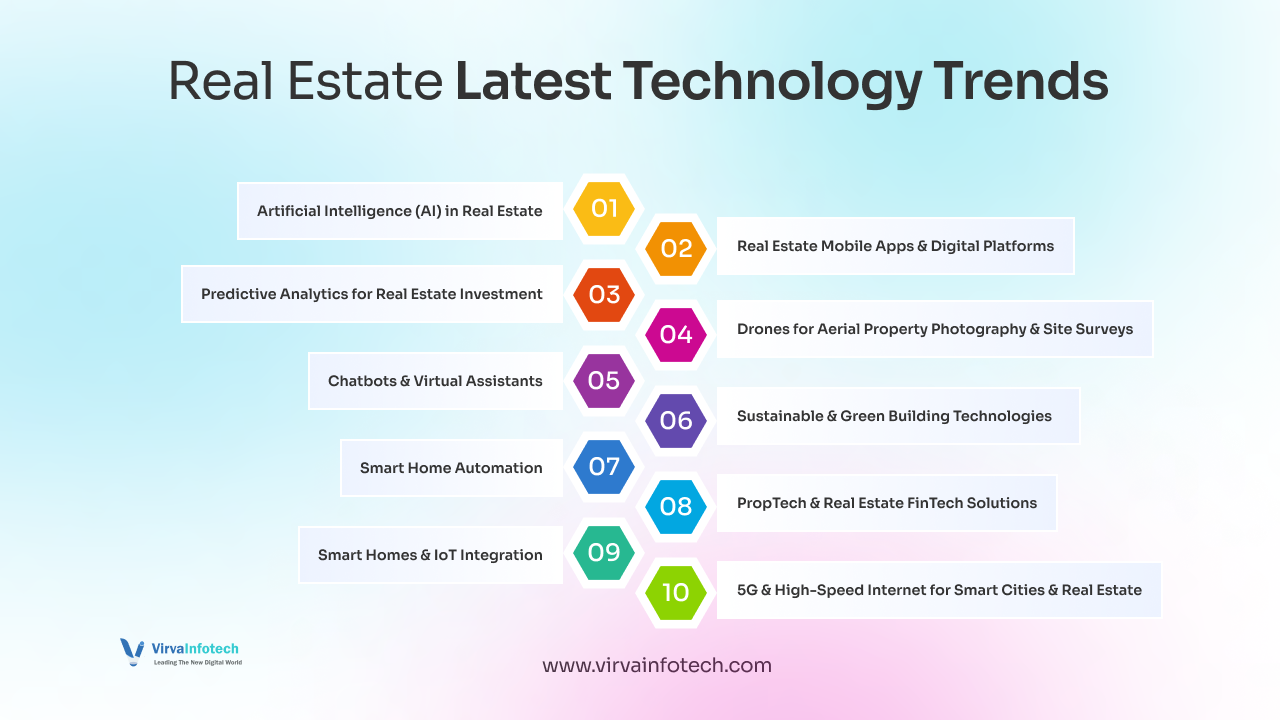
Latest Real Estate Technology Trends
1. Artificial Intelligence (AI) in Real Estate
Artificial intelligence is revolutionizing the real estate industry by improving decision-making, automating processes, and enhancing user experience. In the USA, AI-powered platforms are widely used for property recommendations, pricing predictions, and customer engagement.
AI enables real estate businesses to analyze large volumes of data, understand buyer behavior, and provide personalized experiences. This not only reduces manual effort but also increases efficiency and conversion rates.
Key Applications:
AI-Powered Property Recommendations
- Suggests properties based on user behavior and preferences
- Reduces search time and improves user experience
- Used by platforms like Zillow and Redfin
Predictive Analytics for Investment
- Forecasts property prices and ROI
- Helps investors identify high-growth locations
- Reduces investment risks
AI Chatbots & Virtual Assistants
- Provides 24/7 customer support
- Automates lead generation and follow-ups
- Improves response time and engagement
Smart Home Automation
- Controls lighting, security, and temperature
- Integrates with voice assistants
- Enhances convenience and energy efficiency
2. Blockchain for Secure Property Transactions
Blockchain technology is transforming real estate transactions by making them more secure, transparent, and efficient. In the USA, it is increasingly used for digital contracts, ownership verification, and fraud prevention.
By eliminating intermediaries, blockchain reduces transaction costs and speeds up property deals.
Key Benefits:
- Tamper-proof property records
- Secure and automated smart contracts
- Reduced fraud and paperwork
- Faster transactions
3. Virtual Reality (VR) & Augmented Reality (AR)
VR and AR technologies are redefining property viewing experiences. Buyers can now explore properties remotely without physically visiting them.
These immersive technologies are especially valuable in the USA market, where remote property buying is growing rapidly.
Key Use Cases:
- 3D virtual property tours
- AR-based interior visualization
- Virtual staging and design previews
- Remote property showcasing
4. Big Data & Predictive Analytics
Big Data plays a crucial role in helping real estate businesses make informed decisions. By analyzing historical and real-time data, companies can identify trends, predict prices, and understand customer behavior.
In the USA, data-driven strategies are essential for competitive advantage.
Key Benefits:
- Accurate property pricing
- Personalized recommendations
- Risk assessment for investors
- Market trend analysis
5. Smart Homes & IoT Integration
Smart home technology is becoming a standard feature in modern properties across the United States. IoT devices allow homeowners to control appliances, security systems, and energy usage through mobile apps.
This trend is increasing property value and attracting tech-savvy buyers.
Key Features:
- Voice-controlled automation
- Smart security systems
- Energy-efficient devices
- Remote home management
6. Real Estate Mobile Apps & Digital Platforms
Mobile apps have become essential tools for property search, transactions, and customer management. These platforms provide users with real-time data and seamless digital experiences.
Businesses investing in custom mobile application development services are able to deliver feature-rich platforms that enhance engagement and conversions.
Key Features:
- Property search with advanced filters
- AI-driven CRM systems
- Digital mortgage and loan platforms
- Real-time notifications
7. Drones for Property Marketing & Surveys
Drones are widely used in real estate for aerial photography, site inspections, and land surveys. They provide high-quality visuals that improve marketing and decision-making.
In the USA, drone technology is helping developers and agents showcase properties more effectively.
Key Benefits:
- High-quality aerial images and videos
- Real-time construction monitoring
- Cost-effective land surveys
8. Sustainable & Green Building Technologies
Sustainability is becoming a major focus in the real estate industry. Green buildings and eco-friendly materials are gaining popularity among buyers and investors in the USA.
These technologies reduce environmental impact while lowering long-term costs.
Key Features:
- Energy-efficient buildings
- Solar-powered homes
- Water conservation systems
- Eco-friendly construction materials
9. PropTech & Digital Real Estate Platforms
Property technology (PropTech) is transforming how real estate businesses operate. From investment platforms to digital leasing systems, technology is making real estate more accessible and efficient.
Companies looking to scale their platforms often choose to hire software developers in the USA to build secure and high-performance solutions.
Key Innovations:
- AI-driven investment platforms
- Real estate crowdfunding
- Digital rental payments
- Online leasing agreements
10. 5G & Smart City Development
The rollout of 5G technology is enhancing connectivity and enabling real-time data processing in real estate applications.
This is playing a major role in the development of smart cities across the USA.
Key Benefits:
- Faster property search and app performance
- Seamless VR/AR experiences
- Real-time data updates
- Improved smart home connectivity
Modern real estate businesses also require powerful CRM systems, enterprise dashboards, and digital workflow automation to manage leads, agents, and customer experiences efficiently. Many companies rely on enterprise software solutions USA to streamline operations and improve long-term scalability.
Conclusion
The real estate industry in the USA is being transformed by technology at an unprecedented pace. From AI and blockchain to AR/VR and IoT, these innovations are making real estate more efficient, transparent, and user-friendly.
Businesses that embrace these trends can gain a competitive advantage and deliver better experiences to customers. Whether you're an investor, developer, or real estate company, adopting modern technology is no longer optional—it’s essential for growth.
If you're planning to build a real estate platform, understanding the full app development process is equally important. You can also explore our complete real estate app development guide to learn about features, costs, and the right technology stack for scalable property applications.
Looking to build a modern real estate platform for the USA market? Our development team helps real estate businesses create scalable mobile apps and digital platforms with AI-powered property search, virtual tours, CRM integration, smart automation, and secure transaction systems.